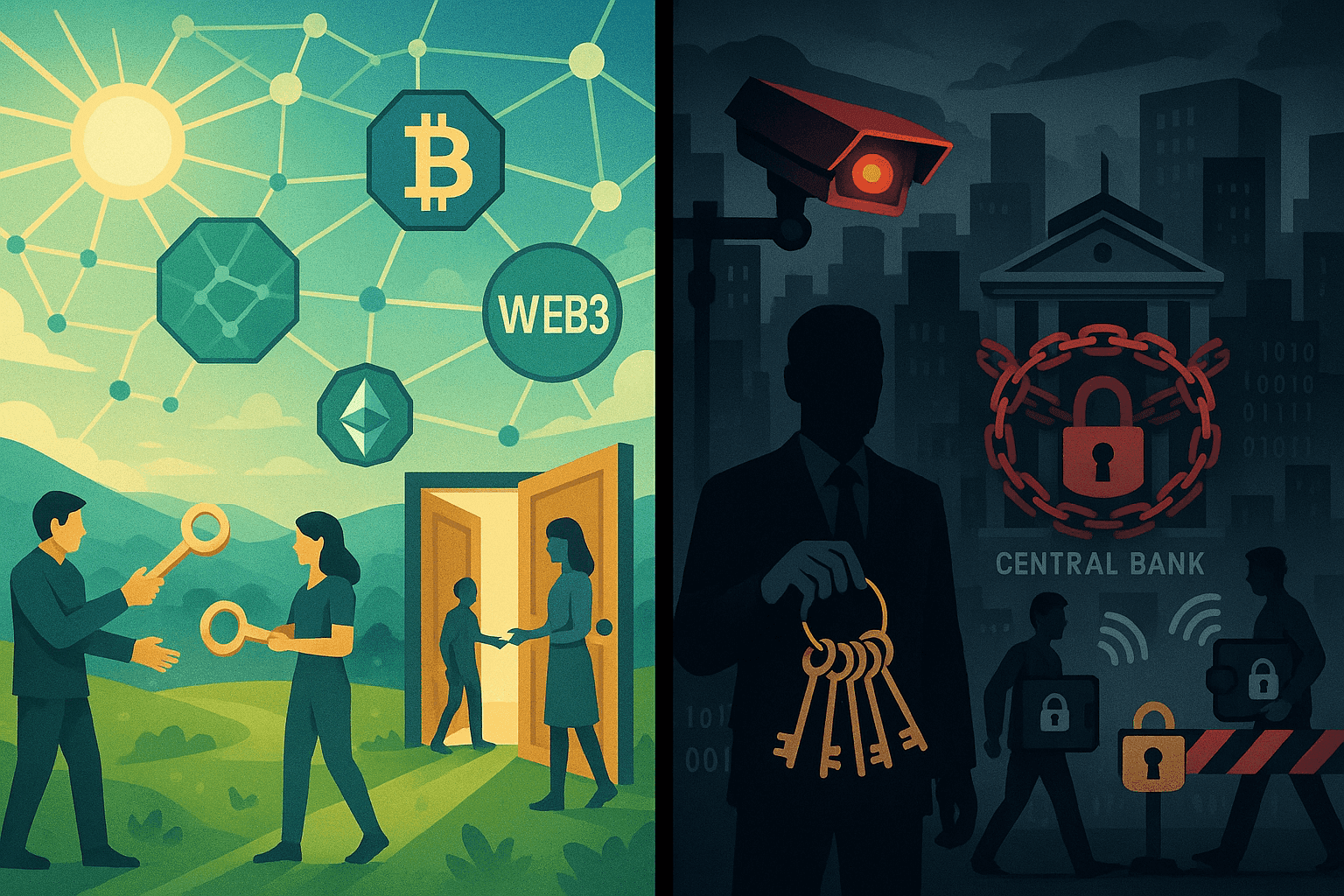
In today's digital world, we constantly hear about cryptocurrencies, Web3, digital wallets, and government plans to introduce official digital currencies. For many, these terms blur together, creating a confusing and unclear picture of the future of finance. However, the differences between them are fundamental, and they revolve around one of our most important values: our freedom.
In this article, we'll explain why you shouldn't confuse technologies that empower freedom, like cryptocurrencies, with tools of potential control, like Central Bank Digital Currencies (CBDCs).
Crypto & Web3: Technology in Service of Freedom
At the heart of cryptocurrencies and the Web3 movement lies decentralization. This is the key word that separates them from everything proposed by governments and central banks.
What Are Cryptocurrencies?
Cryptocurrencies, like Bitcoin, are digital money not controlled by any central authority—neither a government nor a bank. They operate on blockchain technology, which is a distributed database maintained by a network of thousands of computers around the world.
The core values and benefits of cryptocurrencies:
Censorship Resistance: Because the network is decentralized, no single institution can freeze your funds or stop you from making a transaction. You are in full control of your money.
Financial Freedom: They give you the ability to send value anywhere in the world, without intermediaries, and with more privacy than in the traditional banking system.
Global Access: Anyone with an internet connection can be part of this system, without needing permission from a bank.
What is Web3?
Web3 is the vision for a new generation of the internet, built on the foundations of decentralization and blockchain technology. Unlike today's internet (Web2), which is dominated by large corporations that control our data (like Google or Facebook), Web3 aims to give power back to the users.
The core values and benefits of Web3:
Data Ownership: In Web3, you own your data and your digital identity, not the platforms you use.
No Central Point of Control: Web3 applications and services run on decentralized networks, making them incredibly resistant to censorship by governments or corporations. They can't simply be "shut down."
Greater Transparency: The rules of many Web3 systems are public and verifiable, which builds trust without needing to rely on the reputation of a single company.
CBDCs and Government Wallets: A Pretty Name for Total Control
At first glance, Central Bank Digital Currencies (CBDCs) might seem similar to cryptocurrencies—after all, they are both "digital." However, beneath this surface-level similarity lies a completely different philosophy.
What is a CBDC?
A CBDC is a digital version of a country's official currency (e.g., a digital dollar, a digital euro), issued and fully controlled by a central bank. Unlike cryptocurrencies, a CBDC is a centralized system. This means one entity—the state—has absolute power over it.
The End of Cash and Digital Shackles
Plans to introduce CBDCs often go hand-in-hand with efforts to limit or completely eliminate cash. Why is cash so important? Because it is anonymous and it gives you freedom. When you pay with cash, you don't leave a digital trail. No one is analyzing your daily purchases.
In a world based on CBDCs and government digital wallets, the situation would be dramatically different.
The potential dangers of CBDCs and a cashless society:
Total Surveillance: Your every transaction would be recorded and monitored by the state. The government would know exactly what, where, and when you buy. This is the end of financial privacy.
Programmable Money: A CBDC can be "programmable." This means the authorities could impose rules on your money. Examples include:
Allowing your funds to be spent only on certain products (e.g., food, but not fuel or certain books).
Setting an "expiration date" on your savings to force you to spend them.
Blocking you from paying individuals or organizations deemed "politically incorrect" by the authorities.
Financial Censorship: The government could freeze your funds with a single click at any time, cutting you off from the ability to function in society.
Exclusion: The elderly or those without access to digital technology could be completely excluded from the financial system.
Comparison: Cryptocurrencies vs. CBDC
Control
Cryptocurrencies: Control over funds is in the hands of the users. No authority can directly freeze or block your assets.
CBDC: Full control belongs to the state or central bank. Authorities can block funds or transactions at any time.
Privacy
Cryptocurrencies: Offer a high level of privacy—transactions are pseudonymous and not directly linked to your real-world identity.
CBDC: Privacy is very limited or non-existent—every transaction is monitored by the state.
Censorship Resistance
Cryptocurrencies: Very high—it's practically impossible for a single entity to block transactions.
CBDC: No censorship resistance—the state can freely block funds or selected transactions.
Issuance
Cryptocurrencies: Issuance is decentralized and often limited by an algorithm (e.g., Bitcoin has a maximum number of coins).
CBDC: Issuance is centrally controlled by the central bank, which can decide the amount of money in circulation.
Philosophy
Cryptocurrencies: Focus on freedom, individual sovereignty, and removing the need for trusted intermediaries.
CBDC: Focus on control, surveillance, and maintaining the power of central institutions.
Conclusion: Don't Be Fooled
It is crucial that we, as a society, understand the fundamental difference between technologies that give us freedom and control, and those that can take them away. Cryptocurrencies and Web3 offer a vision of a decentralized world where the individual has more sovereignty. A CBDC, promoted as a modern and convenient solution, could in reality become a tool of unprecedented social control.
Defending cash and being aware of the threats posed by centralization are among the most important challenges for protecting our rights and freedoms in the digital age.
.png&w=640&q=75)